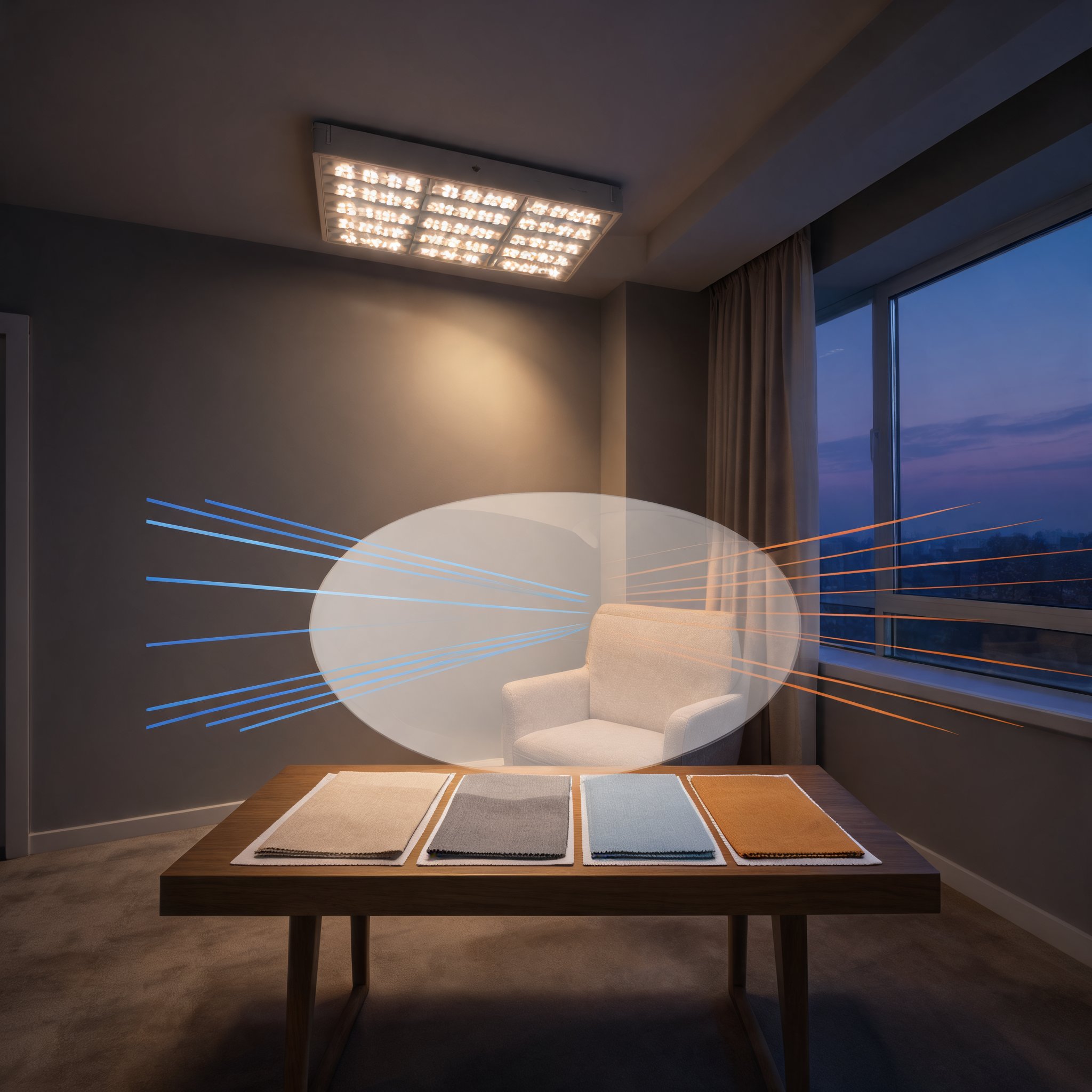
For a senior-living project, an 80 CRI luminaire can look like a compromise. Color rendering scores are easy to compare, and a lower number usually invites questions. A study in Optics Express suggests that the comparison can mislead when the viewer is older. A custom-mixed LED spectrum rated only 80 CRI helped people in their 70s and 80s sort colors more accurately than a simulated daylight reference rated 97. The low score was not the objective; the spectrum was tuned for aging eyes.
The research comes from Fudan University in Shanghai, with two Opple Lighting employees among its eight authors. It starts with a physiological problem. The eye’s lens yellows with age and filters out short-wavelength light. Ra and TM-30, the color metrics specifiers commonly use, are calculated with a fixed standard observer that makes no allowance for lens aging, even though the CIE’s own 2006 physiological model includes an age parameter. A specification can therefore describe how a young standard observer would see a spectrum while saying little about how an 80-year-old would see it.
A metric for lost color discrimination
The team modeled the color response of aging eyes and created two metrics. One estimates how much lost color discrimination a spectrum recovers for an older viewer. The other measures color fidelity against a 32-year-old’s perception. The researchers screened 11,541 candidate spectra from a 16-channel LED luminaire, all at 5000 K and all with Ra of at least 80. They then tested two candidates against a simulated D50 daylight reference with Ra of 97. P1 prioritized discrimination at Ra 80. P2 balanced discrimination and fidelity at Ra 90.
The ranking depended on the observer. When the authors re-ranked every candidate using the conventional standard observer, P1 lost its top position. That result is the study’s most direct challenge to current practice: the spectrum favored by a spec sheet and the spectrum favored by an aging eye can be different lights.
The human test
Participants aged 70 and older, with a mean age of 81.7, sorted colored caps from the Farnsworth-Munsell 100 Hue test in a viewing booth at 300 lux. Mean error scores fell from 79.2 under the reference to 62.4 under P1 and 65.0 under P2. Both reductions were statistically significant. Color discrimination improved for 26 of 34 participants, or 76.5%, under P1 and for 22 of 34, or 64.7%, under P2. The difference between the two optimized spectra was not statistically significant.
The study also asked whether fruits and vegetables looked natural. Twenty-eight participants said yes under P1, compared with 26 under both the reference and P2. A two-person difference proves little, but it suggests that the lower Ra of P1 carried no obvious penalty in perceived naturalness in this setting.
What the evidence can and cannot support
The sample was small, and the authors are explicit about its limits. People with advanced cataracts, glaucoma or macular degeneration were excluded. That exclusion removes many of the residents a memory-care designer may be lighting for. Chromaticity between the reference and test lights was not perfectly matched. The naturalness question was a simple yes or no. The authors also warn against reading 300 lux as a recommendation. These are not footnotes to the result; they define the distance between a laboratory finding and a specification.
Funding and product development add another boundary. Opple financially supported the study, according to the paper’s disclosures. The paper names no product, but a news release distributed through Optica, the journal’s publisher, says Opple is now working to translate the findings into lighting products. That makes the work early product development as much as academic research. The underlying data is available only on request, so independent replication matters.
The fixture gap
The method requires at least four independently controlled LED channels. Multichannel color-mixing fixtures rarely appear in a care-facility bid. Most products sold as tunable in healthcare and senior living adjust color temperature across two channels, which would not reproduce these spectra. That gap is an inference from the study’s method and the product landscape described, not a claim in the paper, but it is central to the practical question. A result can be technically meaningful and still be unreachable through the products normally specified for the space.
For lighting people in senior living and healthcare, the study raises a pointed question. The industry’s color metrics make no allowance for aging eyes, and a growing share of building occupants are well past middle age. If a tuned spectrum can help residents read a medication label or judge whether food has spoiled, the debate shifts from whether the metric is imperfect to how quickly the evidence reaches specifications and product lines, and whose products get there first. The 80 CRI number is not the story. The observer behind it is.