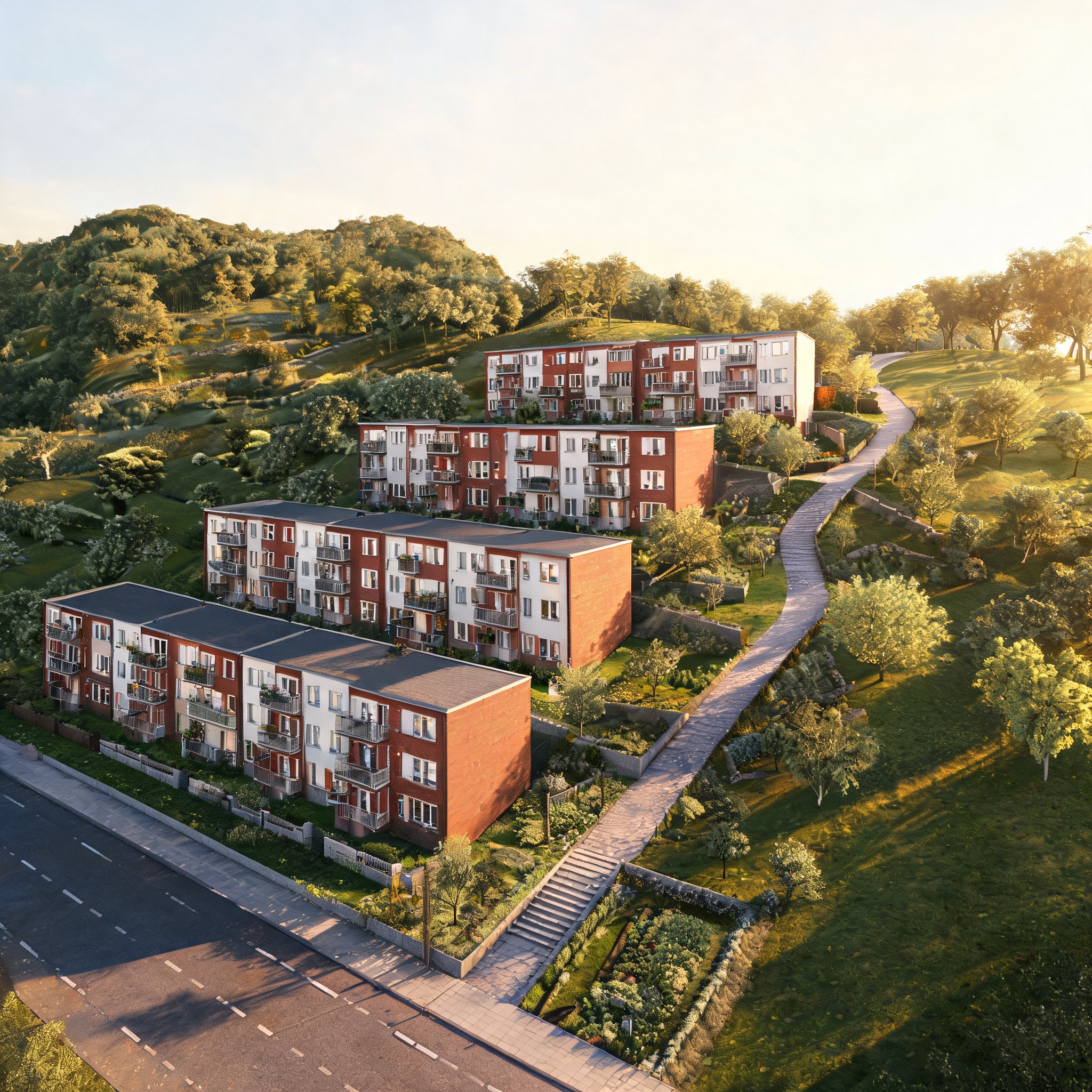
The RIBA Stirling Prize 2026 has been awarded to Lion Green Road, a 157-home council housing scheme in Coulsdon, south London, designed by Mary Duggan Architects with RUFF Architects. The five-block development was built for Croydon Council by main contractor CField Construction under a £34m contract.
The project occupies the site of a former car park and had to contend with a sloping plot that changes level by eight metres. Rather than treating the gradient as an obstacle, the design uses the site's changing levels and views to connect the busy Lion Green Road with an area of green parkland beyond. The result is described as a new living landscape for 635 residents.
The scheme's five blocks share a consistent specification but vary subtly in height and orientation. According to the jury, that approach allows housing at scale without producing uniformity. It also supports a garden-neighbourhood character in which private space and generous views sit alongside a strong relationship with nature.
The scheme's design response is therefore twofold. It reorganises a former car-park site into a residential neighbourhood, and it uses the eight-metre fall across the plot to create routes and outlooks between the street and the parkland. The jury's praise centres on the balance between a consistent specification and variation in height, orientation and setting.
Chris Williamson, RIBA President, speaking for the jury, said the award came at a time when more homes are urgently needed. He argued that Lion Green Road demonstrates how density can be increased without compromising the quality of the places created. He also highlighted the architects' use of a consistent specification and controlled variation to deliver scale without repetition, and described the design as thoughtful, resourceful architecture that shows even a difficult site can be turned into a distinctive place to live.
The project also sought to reduce carbon emissions through efficient construction methods, simple finishes and a more streamlined building process. No figures for the reduction are provided, but the approach is presented as part of the scheme's environmental performance.
The award recognises both the delivery of council housing and the architectural handling of a constrained urban site. For Croydon Council, the scheme adds 157 homes on previously developed land; for the design team, the prize highlights how local-authority housing can combine volume, landscape and a clear identity. The jury's comments place particular weight on the project's ability to make density feel like a neighbourhood rather than a set of repeatable block types.