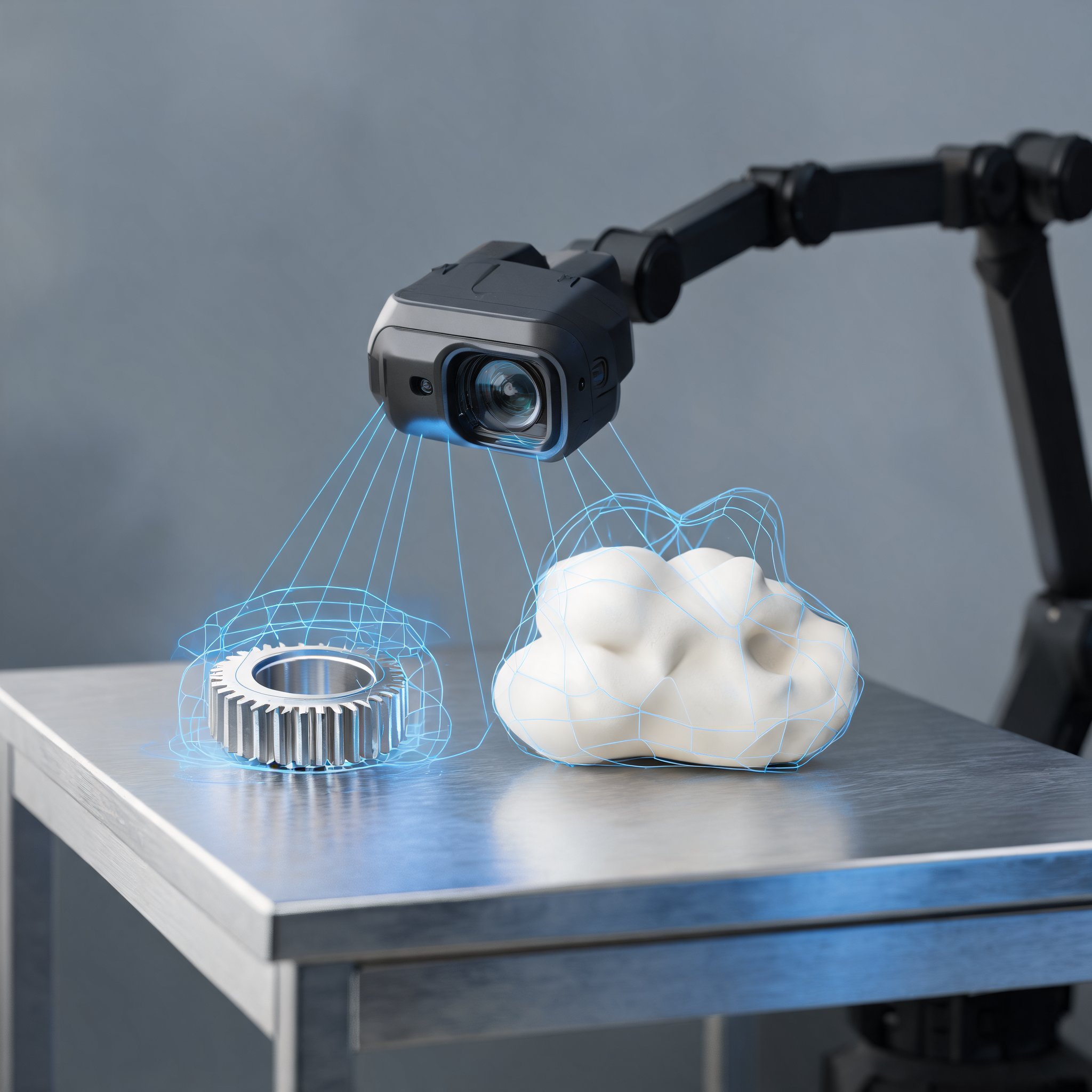
ELEGOO has launched the M1 Ultra, its first all-in-one smart 3D scanner, taking the Chinese 3D printing brand into digital capture. The device went on sale on October 29, 2026, at a standard retail price of USD 1,699, with early-bird pricing of USD 1,599 available through November 12. ELEGOO is positioning the scanner for professional work in customization, reverse engineering, education, digital archiving and other creative projects.
The M1 Ultra combines blue-laser scanning accuracy of up to 0.02 mm with five scanning modes and a scan-to-model workflow. Kevin Wang, co-founder and vice president of ELEGOO, said the company aims to bring precision, versatility and workflow efficiency into one integrated solution, making advanced 3D scanning more accessible. He described the launch as an important step in expanding ELEGOO’s 3D creation ecosystem and connecting physical and digital objects.
Accuracy and capture hardware
ELEGOO specifies volumetric accuracy of 0.02 mm + 0.06 mm/m and describes the scanner’s precision as metrology-grade. To support consistent results, the M1 Ultra uses an all-glass optical system, intelligent temperature compensation and high-precision camera calibration. Global-shutter cameras are intended to reduce motion blur and distortion during scanning. The scanner also captures 24-bit full-colour texture mapping with image signal processing optimization, recording an object’s appearance alongside its geometry.
Five modes for different objects
The five scanning modes address different object sizes and surface conditions:
- A 34-line blue laser mode is intended for medium-to-large objects.
- A 7-line blue laser mode targets fine details on small-to-medium parts.
- A single-line blue laser mode is designed for deep holes, narrow gaps and other hard-to-reach areas.
- An infrared structured light mode covers face, body and object scanning.
- A marker-free blue laser mode offers an alternative where applying markers is not practical.
The scanner supports objects from 5 × 5 × 5 mm³ up to 4,000 × 4,000 × 4,000 mm³. ELEGOO also says it can scan black and metallic surfaces without coating powder, which the company says provides greater flexibility across materials and environments.
Portable hardware and software workflow
The handheld M1 Ultra has a 3-inch HD touchscreen, Wi-Fi 6 connectivity and a 4,800 mAh swappable battery that supports up to 1.5 hours of wireless scanning. ELEGOO says the lightweight, ergonomic body is intended to make it easier to move between workspaces and scan objects in different settings.
The bundled ELEGOO SCAN software provides guided setup, tracking assistance and multi-scan alignment. Automated one-click processing handles mesh wrapping, mesh optimization and colour mapping. Scan data can be exported in STL, OBJ, PLY and ASC formats for compatible third-party design, modelling and manufacturing software.
Standard prices are USD 1,699, EUR 1,699, GBP 1,399, CAD 2,399 and JPY 299,999. Early-bird prices through November 12 are USD 1,599, EUR 1,599, GBP 1,319, CAD 2,299 and JPY 284,999.
Consumer brands widen the workflow
The M1 Ultra extends ELEGOO’s product ecosystem from 3D printing into scanning. Other consumer-focused companies are pursuing similar combinations. At IFA 2026 in Berlin, Creality introduced a lineup spanning multicolour printing, filament recycling, resin printing, 3D scanning, laser processing and 3D printed footwear. Its Pika 3D scanner uses a seven-line blue laser and near-infrared scanning in a 260 g body, with accuracy to 0.03 mm and scan speeds up to 110 fps.
Revopoint’s Trackit SR wireless 3D scanner continues the company’s push to offer marker-free optical tracking metrology, a category historically dominated by high-cost industrial systems, at lower price points. It has single-frame accuracy of 0.02 mm and three scanning modes, including a Deep Hole Mode that uses a single blue laser line. 3DMakerpro has focused on ease of use with the Toucan all-in-one scanner, which lets users scan, edit and fuse complete models without a computer.
As consumer brands add scanning to their portfolios, capturing objects is becoming part of the same workflow as making them. ELEGOO is now competing in both areas.