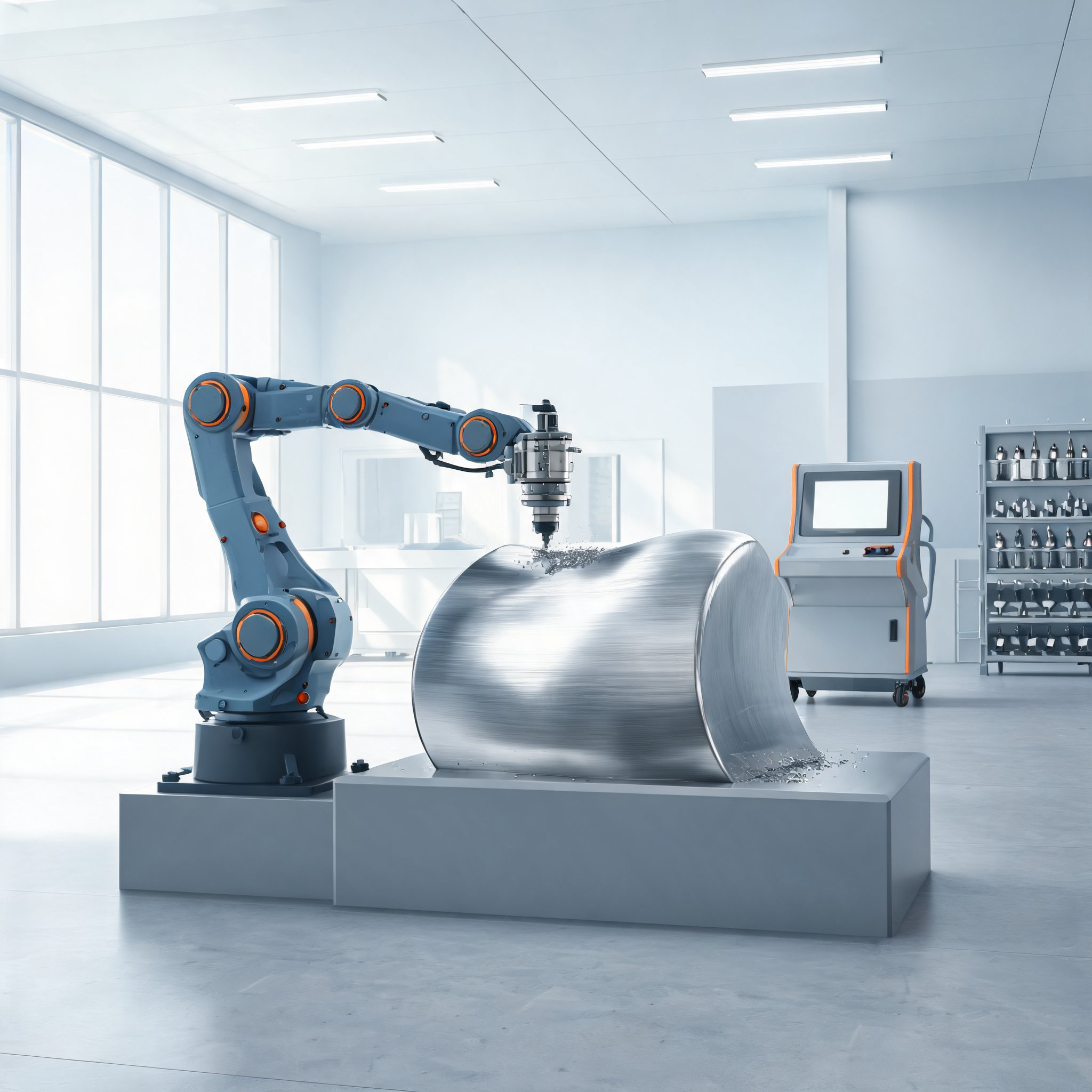
Fives High Precision Machines (Fives HPM) is offering the Liné Machines RoboTDM, a robotic machining system intended for large workpieces that do not require the full capability of a large CNC machine tool. The system performs milling, trimming and drilling by carrying a spindle-equipped end effector on an industrial robot, rather than moving the part into a large machine envelope.
Fives says the approach suits applications where tolerances down to roughly 0.1 mm are acceptable. In that band, the company argues, a large CNC machine can impose unnecessary capital cost, footprint, setup time and programming burden. RoboTDM is presented as a complementary option rather than a replacement for high-precision CNC equipment; work requiring tighter than 0.1 mm remains the domain of conventional high-precision machine tools.
From robot motion to machining accuracy
Standard industrial robots typically reach positional tolerances around 0.3 mm, which Fives says is insufficient for many machining tasks. Its development work focuses on high-precision robotic machining. Robot calibration, look-ahead and motion-planning algorithms allow programs with more than one million points to run without the latency that can otherwise distort robot motion, according to the company. Fives says this yields smoother trajectories and supports multi-axis contouring and complex operations more comparable with CNC machining.
The company reports that RoboTDM can hold deviation down to about 100 μm, or 0.1 mm, compared with roughly 0.3 mm for conventional robotic systems—a threefold improvement. The figures are attributed to Fives’ development and trial work.
Tooling and process options
The end effector can be configured with different spindle sizes, power ratings, torque and speed. Fives lists spindle power up to 125 kW, torque up to 80 Nm and speeds up to 30,000 rpm, with HSK A63, HSK F63 or HSK A100 toolholders. Optional functions include automatic tool changing, tool measurement, tool-breakage detection and part probing; a vision system can support drilling.
Beyond machining, the platform can be configured for waterjet cutting, laser profiling and ultrasonic cutting. Fives also points to multiple workstations and customized peripheral equipment. Because the robot can be brought to the workpiece, the system has relatively modest foundation requirements compared with a large CNC machine, which the company says can simplify installation.
Applications and reported gains
Target operations include face milling and deburring metal parts, removing burrs from castings, trimming excess weld beads, drilling pilot holes in large aerospace panels or automotive body parts, and trimming, routing, drilling, edge contouring and pocketing large composite or thermoplastic fabrications.
Fives says a multi-year research and development project and development trials demonstrated cycle-time reductions of up to 70% in trimming and milling, with some individual applications achieving greater savings. The company does not identify specific customer installations or provide independent production data in the information described.
The company sees particular potential in aerospace, defense, maritime and energy, where components can be large and production requirements vary. It describes RoboTDM as an option between conventional robotics and a large CNC machine tool, with possible advantages in capital investment, installation simplicity, flexibility and cycle time for suitable parts.
Organization and support
RoboTDM sits within Fives’ Material Removal business line and reflects the wider Fives HPM “precision at scale” approach, according to the company. Fives says the Liné Machines brand contributes decades of experience in large-scale milling and material removal, and that the product was shaped by customer requirements rather than by adapting a standard machine.
Fives Liné Machines Inc., now part of Fives HPM, has operated in North America for almost 50 years from its Granby, Quebec, Canada facility. The plant produces Liné CNC machine tools and robotic solutions, including RoboTDM, and supports engineering, integration, automation, service and training across equipment lifecycles.