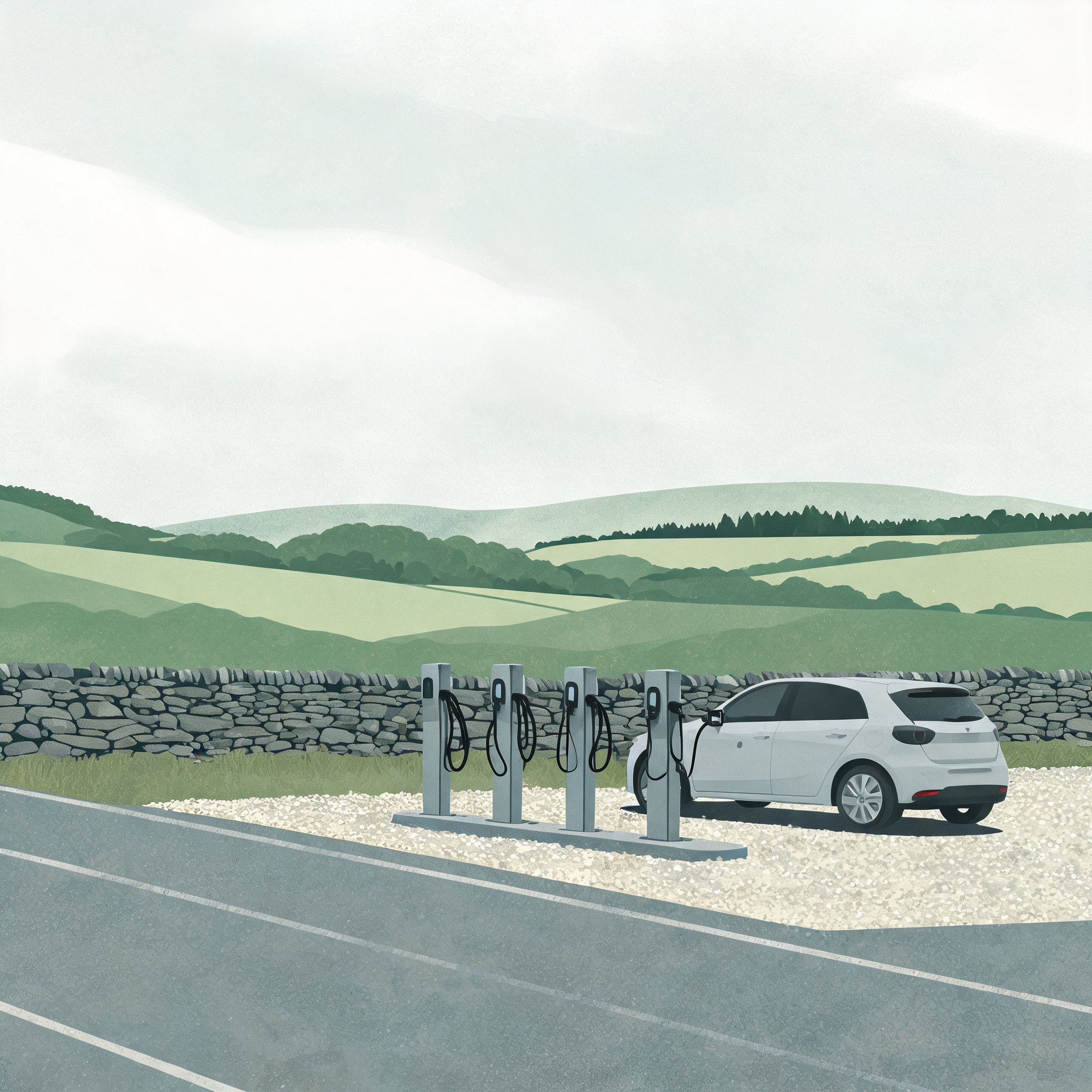
Northumberland County Council has passed a motion to add 36 public electric vehicle charging points at 26 locations, extending the network the authority already runs across the county in the north-east of England.
Most of the new equipment will stand on council-owned ground. Seventy-eight per cent of the charge points are to be installed on land owned by the council, which gives the authority direct control over siting and upkeep at those sites; the remaining units will go on land held by third parties under licensing agreements, so those locations depend on terms agreed with other landowners.
Northumberland borders Scotland and takes in Hadrian's Wall and Northumberland National Park, and the 36 additions will be spread over 26 separate locations rather than concentrated on a handful of sites.
The rollout is being financed with just over £1 million in external funding from the City Region Sustainable Transport Settlement. Revenue generated by the chargers will be used to meet their running costs, management and maintenance, and the funding is intended to support installation of the points until 2029.
With the capital cost carried by an external settlement and running costs met from charger revenue, upkeep at the sites depends on usage rather than on annual budget allocations.
Installation and upkeep will be handled by the council's in-house EV team, which will fit and maintain the units rather than passing the work to an outside contractor. Keeping the work in-house means the same team is responsible for both fitting and servicing the equipment.
Richard Wearmouth, the cabinet member with responsibility for transport at Northumberland County Council, said it was good to see more investment going into EV charging provision in the county. He noted that Northumberland has one of the largest road networks in the country and that the necessary facilities are needed to help people get around.
The decision follows other sustainable transport spending in the region: 14 BYD BD11 battery-electric buses entered service a few months before the charging motion.
Details such as charging speeds and grid connection capacity at the 26 sites have not been set out, and no site-by-site timetable has been announced beyond the 2029 funding horizon.
How quickly the 26 locations become live will therefore depend on the council's installation programme and on licensing progress at the third-party sites, while the value of the expansion for drivers will hinge on where the new points sit relative to the routes they use.