SprintRay used its 3DNext 2026 event in Miami Beach to extend its connected digital dentistry workflow, introducing a wireless intraoral scanner built for its ScanOS software, a compact chairside production line called the Nano Series, and an expanded materials partnership with GC Corporation. The company said it has produced more than 20 million dental parts worldwide.
The scanner, named Foundation, is a wireless, full-colour intraoral scanner designed for ScanOS. According to SprintRay, it brings scanning into the same account and interface used for design and production, so practices can move from digital capture to a finished case without a separate file export or upload step after scanning. The company expects to launch Foundation officially in the United States, with first shipments expected in November 2026.
Compact chairside production
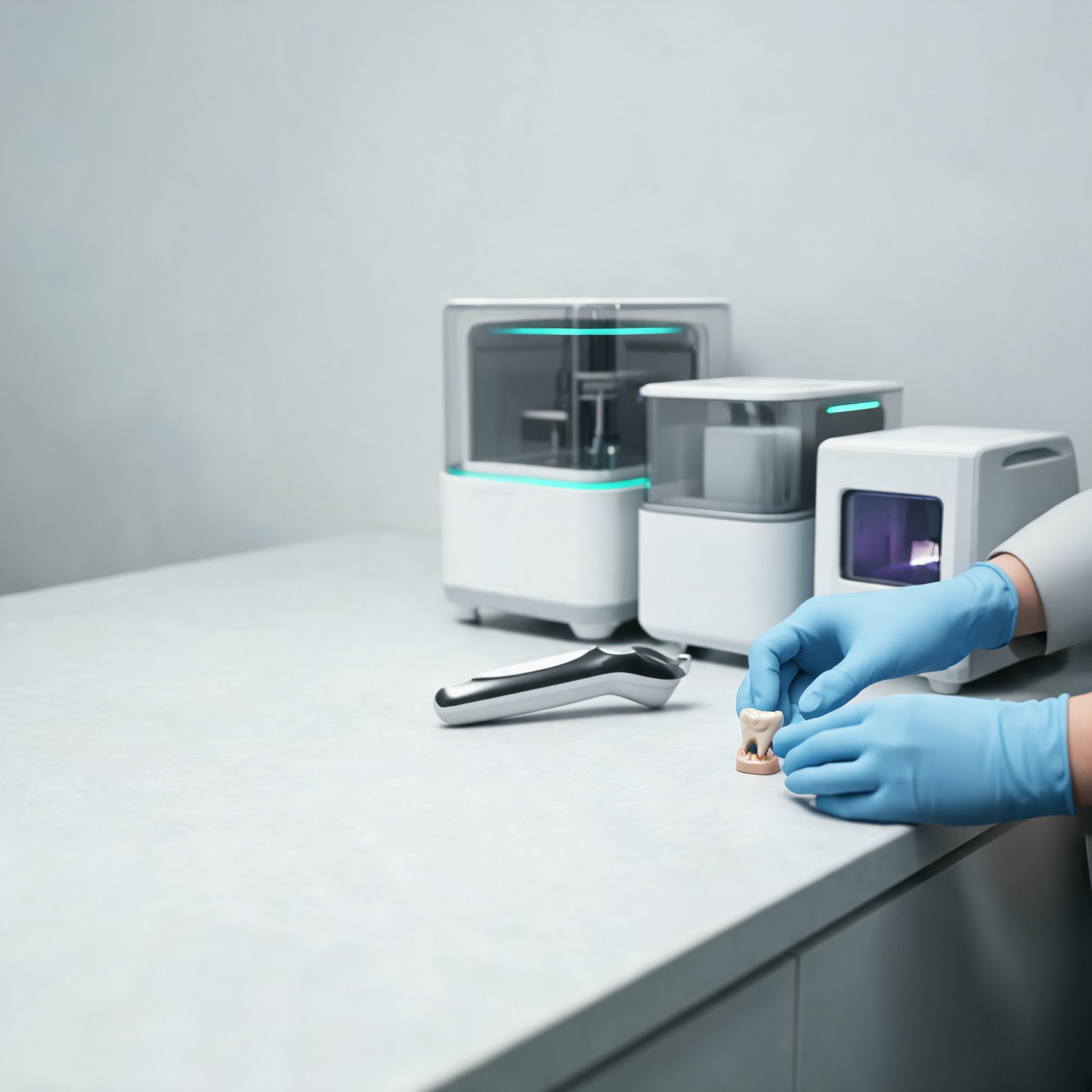
The Nano Series targets what SprintRay estimates is about 80% of chairside print jobs involving a single patient and a single case. It comprises NanoPrint, NanoWash and NanoCure, which the company describes as a connected print, wash and cure workflow occupying less than 30 inches of counter space. NanoPrint uses a 385 nm light engine, NanoWash automates washing and drying, and NanoCure completes post-processing. AutoPrint and Job Handoff are intended to connect production steps and carry case information through the workflow.
SprintRay said the Nano Series supports a broad range of clinical applications through its validated materials library, with specific indications and availability varying by market. Shipments are expected to begin in November 2026 in the United States, Canada, Australia, New Zealand and the European Union, subject to applicable regional regulatory requirements and product availability. The company noted that NanoWash is not part of the Canadian launch offering.
GC materials partnership
Separately, through a partnership with GC Corporation, SprintRay has launched GC GRADIA PREMi, a hybrid ceramic restorative resin developed for the SprintRay Midas Digital Press workflow. The collaboration combines GC's restorative materials expertise with SprintRay's capsule-based Digital Press platform, with the aim of expanding material options for definitive chairside restorations. SprintRay said specific clinical indications, performance claims and regional availability remain subject to GC's final approved product labelling and regulatory review.
Amir Mansouri, co-founder and CEO of SprintRay, said the company had for years connected scanning and printing through third-party integrations, but that the experience still required practices to move between systems. He said ScanOS makes scanning a native part of the SprintRay workflow and that Foundation is the first intraoral scanner built for it. Of the Nano Series, he said it was designed to make chairside production more intuitive and practical for the dental team while maintaining the standards clinicians expect from SprintRay. On the partnership approach, he said openness matters but so does validation, describing a strategy of working with leading partners to broaden what clinicians can do while maintaining rigorous workflow standards.