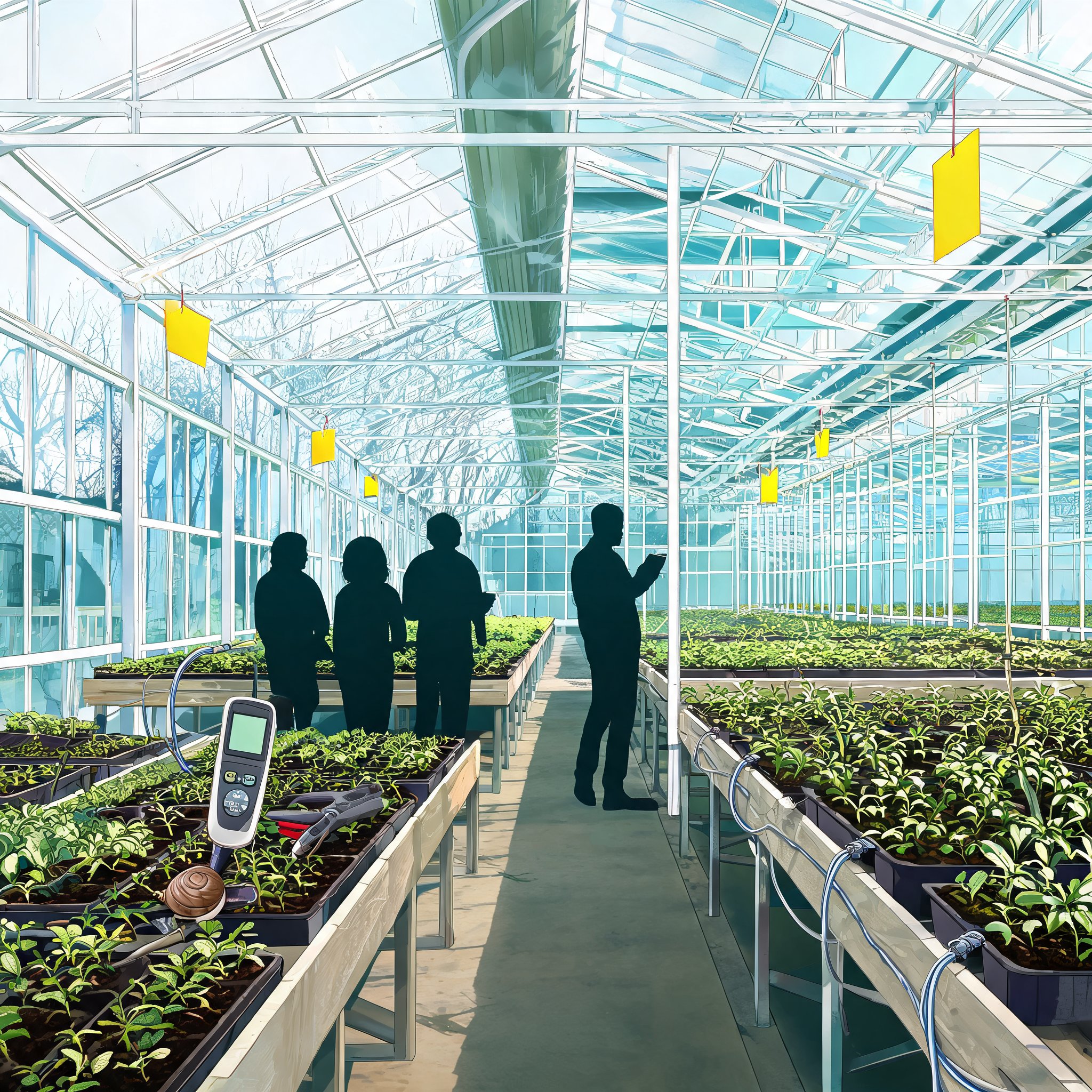
The horticulture industry’s search for capable growers may begin later than it should, according to Jeff Neese, a biological solutions advisor for BioWorks with more than 35 years of experience in commercial horticulture and integrated pest management. Neese argues that high-school vocational horticulture is not a peripheral program but a practical entry point for future growers, IPM specialists, propagators and production managers. His central proposal is that commercial greenhouses should help strengthen school greenhouses instead of waiting for schools to produce job-ready applicants on their own.
Neese’s own career began at Warren Central High School in Indianapolis. He recalls entering a warm, humid, green greenhouse during an Indiana winter and later credits two teachers, Phil Pitts and Pam Greene, with showing him that horticulture could be more than an interest. Pitts brought experience as a grower and landscape designer and set high expectations for student knowledge; Greene taught floriculture. Neese says the program gave him the chance to experience horticulture before he had to decide what to do with his life. He chose to enter the industry rather than attend college and is still working in horticulture more than four decades later. He does not present that choice as a case against college, noting that the industry needs university-trained horticulturists, plant scientists, breeders, researchers and growers. His point is that a four-year degree should not be the only respected route into the profession.
Why early exposure matters
The article describes an industry that frequently discusses the difficulty of finding growers with practical production experience, along with succession planning, recruitment of college graduates, development of assistant growers and competition for a limited pool of horticultural talent. Neese argues that this conversation starts too late. Before asking where the next generation of growers will come from, he says, the industry should ask where young people are supposed to discover horticulture. A 15- or 16-year-old is unlikely to wake up one morning and decide that greenhouse production sounds like a fascinating career. Someone has to show them.
A school greenhouse, however, is not self-sufficient. Neese describes it as a living laboratory that requires knowledge, commitment and time. A greenhouse operation involves crop scheduling, irrigation, fertility, pH and EC management, temperature control, integrated pest management and environmental control. Agriculture teachers may be responsible for broad subject areas, and expecting every one of them to be an accomplished greenhouse grower, crop scheduler, irrigation specialist, diagnostician and environmental-control expert is unrealistic. The article therefore proposes that growers become active partners rather than passive critics of vocational education.
The proposed partnership would not take the greenhouse away from the teacher or dictate curriculum. Commercial growers would serve as a technical resource. They could help develop a workable crop plan, set realistic standards for irrigation, fertility, pH, EC, temperature and crop timing, and walk the greenhouse with students. They could teach students how to scout rather than simply identify a problem, show how sticky cards are used, explain how roots are examined and how nutritional problems are diagnosed, and demonstrate how growers think through decisions. They could also help teachers use existing equipment more effectively and give them a knowledgeable person to call when something goes wrong. Neese argues that the industry holds a large amount of practical growing knowledge, but most of it remains inside commercial greenhouse walls; some of that knowledge should reach the classroom.
The limits of a summer internship
Summer internships are valuable, but Neese does not believe they are sufficient by themselves. For most high-school students, summer is the only extended period for full-time work, and it can give a narrow view of greenhouse production. Depending on the operation, much of the diversity and intensity of spring may be over. The work can be hot and humid, and inexperienced seasonal employees may end up doing tasks nobody else particularly wants that day, such as sticking poinsettia cuttings, spacing crops, moving plants or cleaning houses.
Those jobs are legitimate parts of commercial horticulture, and Neese says every good grower should understand the physical work involved in producing a crop. The problem is that if such tasks are a teenager’s entire exposure, greenhouse horticulture may not appear to be an exciting career. The student has experienced greenhouse labor but not necessarily greenhouse management. To understand growing, students need to see how production changes through the year: fall crops and shortening days, winter’s lower light and humidity challenges, spring propagation and peak production, and summer heat, irrigation demands and preparation for the next cycle. An eight-week internship provides one snapshot; learning horticulture requires seeing the whole sequence.
Neese therefore proposes that school and commercial greenhouses function as extensions of one another. If students have studied pH and EC in class, they should see how a commercial operation monitors them. If they have learned scouting and IPM, they should join a crop walk with the person responsible for those programs. If they have studied irrigation and fertility, they should see the injectors, water systems and fertilizer program. Repetitive production work also becomes more meaningful when students understand the decisions behind it. Sticking a poinsettia cutting can be connected to the production schedule, the rooting phase, the transplant date, the traits growers watch for and the importance of hitting a finished-crop date. The work remains physical, but it becomes a route to learning.
A pipeline, not a single hire
The relationship could also become a recruiting pipeline. A student might first meet a company as a sophomore in a horticulture class, visit the greenhouse or work with a grower as a junior, and continue developing skills in the school greenhouse as a senior while maintaining contact with the operation. By graduation, that young person should not have to wonder whether horticulture can provide a real career. Neese says some of the most rewarding growers he has worked with were people he helped develop. They did not arrive knowing everything; they learned crops and operations from the ground up, took on responsibility and gained confidence because someone invested time in teaching them.
College may be the right next step for many students, and Neese says it should be encouraged when it is. But for students who cannot attend, do not want to attend or, like him, simply want to get started, there should be another respected path. An 18-year-old with several years of vocational horticulture, meaningful commercial exposure and mentorship from experienced growers should not be viewed simply as unskilled labor. That person is a young horticulturist at the beginning of a career and should be given responsibility, continued teaching and a clear view of where the work can lead.
The proposal does not assume that schools can solve the industry’s workforce challenges alone or that commercial growers can solve vocational education alone. Neese sees an opportunity between those two worlds. Growers can continue attending career fairs, posting openings and wondering why applicants lack practical experience, or they can become involved earlier. They can find the agricultural education or horticulture program in their community, meet the teacher, walk through the school greenhouse, ask what is needed and offer knowledge rather than only old equipment and leftover plants. They can invite students into commercial operations in February as well as June, let them scout, test EC, inspect roots, compare strong and weak crops, ask questions and diagnose problems. Summer work should not be only the job nobody else wants; it should give students a reason to want the job someday.
Neese’s conclusion is that the future of horticulture may already be sitting in a high-school classroom. The industry, he argues, should stop waiting for someone else to produce the next generation and help grow it.